Alaska’s youth soccer players are training and competing against a backdrop of worsening statewide mental health indicators and a winter light cycle that researchers have linked to some of the highest recorded rates of seasonal affective disorder in the United States.
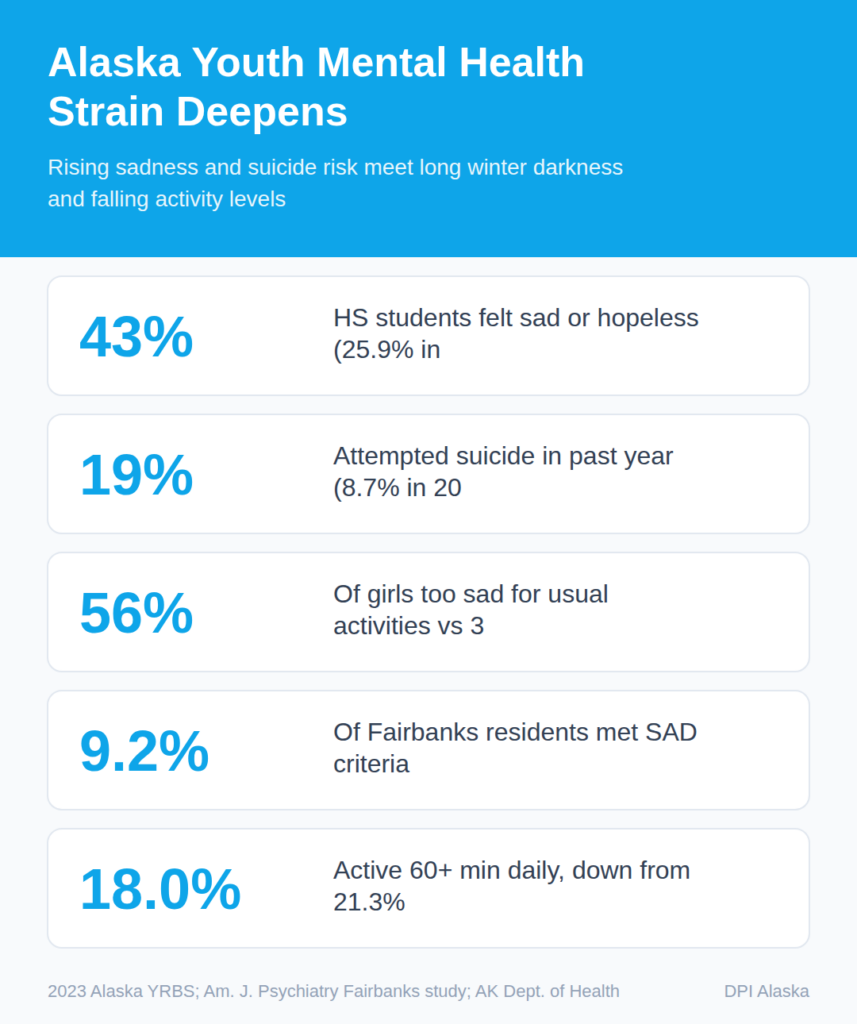
The state’s 2023 Youth Risk Behavior Survey, administered to nearly 1,200 high school students statewide, found that 43% of respondents reported feeling sad or hopeless for periods long enough that they stopped carrying out usual activities — up from 25.9% in 2011, according to Alaska Public Media.
The same survey found 19% of high school students reported attempting suicide at least once in the past year, compared with 8.7% in 2011, and 23% said they had seriously considered suicide, compared with 14.5% in 2011, the Alaska Beacon reported.
Burden falls unevenly by gender
The survey results show a substantial gap between female and male respondents. Among female students in 2023, 56% reported feeling too sad to engage in their usual activities, compared with 32% of male students, according to News From The States.
That disparity has relevance for soccer programs, which in Alaska as elsewhere field both girls’ and boys’ teams from youth club levels through high school. It also parallels findings in seasonal depression research.
Seasonal darkness and its documented effects
A random-sample study of 283 Fairbanks residents published in the American Journal of Psychiatry found that 9.2% met diagnostic criteria for seasonal affective disorder — described at the time as one of the highest prevalence figures yet reported — with winter affective disorders occurring more often in women than in men at a 3:2 ratio, according to the study abstract.
More recent work suggests the figures may be higher among Alaskans who are physically active. In a survey of adult members of a recreational gym in Fairbanks, 18.68% met criteria for winter-pattern seasonal affective disorder and 43.96% met criteria for subsyndromal SAD, commonly called the “winter blues,” researchers reported.
The authors of that study noted that the relationship between physical activity, seasonality and SAD remains underexplored in the research literature, even though physical activity has been shown to improve depression symptoms in general populations, according to the full text published in PMC. In other words, the assumption that staying active insulates athletes from seasonal mood disorders has not been established.
What team sport does — and does not — provide
A systematic review of sport participation among children and adolescents found sport consistently associated with higher self-esteem, greater life satisfaction, and lower symptoms of depression and anxiety, with team sports showing stronger and more consistent benefits than individual sports, according to the review published in PMC.
The review identified self-perceptions, peer belonging and social support as the central mechanisms through which sport supports youth mental health, underscoring sport’s role as a social context for development rather than solely a source of exercise, the authors wrote.
That distinction matters in Alaska, where winter frequently interrupts the outdoor season, disperses teams into indoor facilities with limited availability, and can separate players from teammates for months. If the peer-belonging component is what carries the mental health benefit, then a paused or fragmented season removes more than conditioning.
Sport participation is not a universal protection. Rates of anxiety and depression among elite athletes are now over 30%, and researchers have flagged early sport specialization and increased pressure to compete at high intensity year-round as worrying trends, according to a review of pediatric sports and mental health published by the National Center for Biotechnology Information.
A shrinking base of active students
The population from which Alaska’s soccer teams draw is becoming less active overall. Only 18.0% of Alaska high school students in the 2023 YRBS were physically active for at least 60 minutes on each of the past seven days, down from 21.3% in 2011, according to the Alaska Department of Health and Social Services trends table.
The decline means fewer students are reaching activity thresholds at the same time that reported sadness, suicidal ideation and suicide attempts have risen sharply over the same 12-year period.
Implications for coaches and clubs
The available research points to several considerations for those running youth soccer programs in cold-weather communities.
First, the documented gender gap in both the state survey data and the Fairbanks SAD study suggests girls’ programs may encounter a higher baseline of reported symptoms. Second, because the evidence attributes sport’s mental health benefits largely to peer belonging and social support rather than exertion alone, maintaining team contact through the darkest months — not merely maintaining fitness — aligns with what the research identifies as the active ingredient.
Third, the finding that a Fairbanks gym population reported higher SAD and subsyndromal SAD rates than the general Fairbanks sample cautions against assuming athletes are exempt. Researchers themselves describe the physical activity–seasonality relationship as underexplored.
Finally, the elite-athlete anxiety and depression figures, combined with the identified risks of early specialization and year-round competitive pressure, indicate that expanding indoor winter training volume carries its own considerations alongside the benefits of keeping players connected.
The 2023 Alaska Youth Risk Behavior Survey also recorded some positive trends alongside the mental health findings, as reported by Alaska Public Media and the Alaska Beacon.
Sources
- Survey of Alaska youth reveals more mental health problems, but also some positive trends
- Survey of Alaska youth reveals more mental health problems, but also some positive trends | Alaska Beacon
- Survey of Alaska youth reveals more mental health problems, but also some positive trends | News From The States
- Alaska Youth Risk Behavior Survey Trends, 2011-2023 (Alaska DHSS)
- Prevalence of seasonal affective disorder in Alaska (American Journal of Psychiatry, 1992)
- Seasonal affective disorder and engagement in physical activities among adults in Alaska
- Seasonal affective disorder and engagement in physical activities among adults in Alaska (PMC)
- The impact of sports participation on psychological health and social outcomes in children and adolescents: a systematic review
- The impact of sports participation on psychological health and social outcomes in children and adolescents: a systematic review
- Pediatric Sports: The Mental Health and Psychological Impact of Sport and Injury